Real Estate Investment: Opportunities and risks for doctors


For many medical professionals, real estate is far more than just "concrete gold" or an inflation hedge. It is a currency-independent, relatively stable, and predictable asset class, which is very well suited as a strategic building block for wealth accumulation and retirement planning .
Unlike purely monetary assets (such as call money, fixed-term deposits, or traditional life insurance policies), real estate represents tangible assets, whose development primarily depends on location, demand, and property quality, and less directly on currency fluctuations or short-term whims of the capital markets. Properly structured, real estate allows you to:
- generate ongoing, largely predictable income,
- build wealth long-term,
- and strategically utilize tax benefits.
This article is aimed at medical professionals who view real estate not merely as a "parking spot" for existing assets, but as a consciously employed instrument for professional wealth accumulation.
Advantages: Why Real Estate Can Be an Attractive Investment
Real estate has long been considered a value-retaining asset class. Especially in uncertain times, many investors specifically seek security in tangible assets like real estate. For doctors with a stable income, real estate investments offer several attractive advantages: ongoing cash flows, real assets, and tax benefits.
Stable Rental Income and Wealth Accumulation
A key argument for real estate as an investment is the ongoing rental income, which generates largely predictable, passive income. Unlike highly volatile stock prices or dividends, long-term rental agreements usually offer reliable, monthly cash flows. For medical professionals, this can be a "second pillar" alongside practice or employee salaries, increasing financial independence.
In the long term, a rented property also contributes significantly to wealth accumulation :
- In many regions of Germany, real estate prices have significantly increased over longer periods, especially in economically strong cities.
- At the same time, it holds true: "The tenant pays off the loan"- The rental income covers a large part of the loan installment.
- With each repaid installment, a larger share of the property belongs to you. Your equity grows while the bank debt decreases.
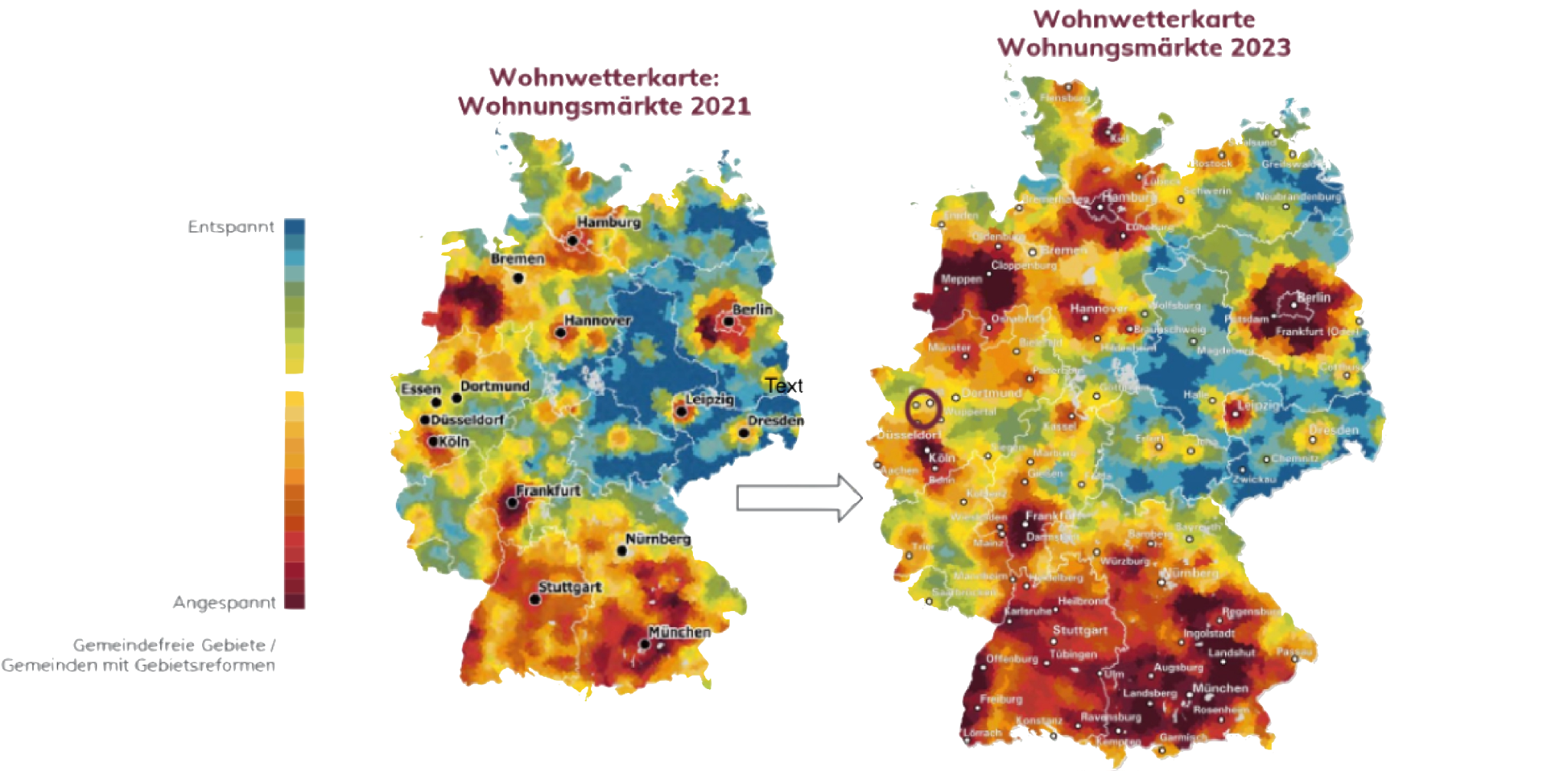
Source: Wohnwetterkarte | https://www.bpd-immobilienentwicklung.de/aktuelles/marktforschung/wohnwetterkarte/
Inflation Protection and Currency-Independent Investment
Real estate is often considered as natural inflation protection . The reason is: While monetary assets lose purchasing power during inflation, real assets usually retain their real value better or even increase in value.
When prices and living costs rise, typically so do rents and property values follow suit. Landlords can adjust rents (within legal regulations) in the medium term, and properties themselves are often valued higher in an inflationary environment over the long term.
More importantly in your context: real estate is more currency-independent than many traditional financial investments. Its value is based on:
- real scarcity of housing,
- location quality,
- and actual demand,
and not just on a promise from a bank or company. Studies and analyses by major institutions like Deutsche Bank confirm that home ownership can provide long-term good protection against loss of purchasing power can offer.
For medical professionals who don't want their hard-earned money to lose value in a savings account, this real asset characteristic is a key advantage.
Tax advantages for real estate investors (e.g., depreciation)
An extremely important advantage of real estate investment is the tax benefits – especially for high-earning professionals, such as doctors.
Key tax levers include:
- Depreciation
- For residential properties, the building value (excluding land) can be depreciated linearly at typically 2% per year over 50 years.
- This applies particularly to new builds and extensively renovated properties; for listed buildings and certain renovations, even higher or special depreciation allowances may be available.
- Interest expenses and ongoing deductible costs
- Interest on real estate loans can be fully deducted as an expense.
- Similarly, ongoing costs – such as maintenance, repairs, property management, and insurance – reduce the taxable income generated from rentals.
- Strategically utilize modernization measures
- If modernizations are classified as maintenance expenses , they can often be claimed as tax-deductible expenses in the year they are incurred or spread over several years.
- This allows a significant portion of the initial investment costs to be recovered through tax filings as early as the year following the investment.
Doctors in particular benefit here disproportionately: For most, 42 cents are reimbursed by the tax office for every euro reported as a loss in the tax balance sheet. In practice, the tax office thus covers a significant portion of your investment. Properly structured, the property therefore becomes a tax-saving model and wealth-building component.
Risks and Disadvantages of Real Estate Investment
As clear as the opportunities are, real estate is not a guaranteed success. Mistakes primarily occur when property quality, location, and financials are not properly vetted.
High Capital Investment, Incidental Costs, and Ongoing Expenses
Real estate requires a significant capital investment. In addition to the purchase price itself, the following costs are incurred in Germany, among others:
- Real estate transfer tax (approx. 3.5–6.5% depending on the federal state),
- Notary and land registry fees (approx. 1–2%),
- Broker's commission (if applicable).
In total, this can easily amount to 5–12% in additional incidental costs, which must be financed or paid in cash. Especially for first-time investors, experts often advise contributing at least 10-20% as equity for the investment.
In practice, problems arise if you:
- only look at the price per square meter and ignore other relevant factors
- are swayed by high, promised rents instead of demanding clear proof of existing demand
- the renovation status, the owners' association minutes, the reserves, and market rents are not seriously checked.
Especially with older properties, a "bargain" with hidden renovation backlogs can quickly become expensive. You then end up with a long-term financial commitment that feels wrong emotionally and economically.
Furthermore, real estate is illiquid. Selling takes time and money, unlike funds or ETFs, which can be quickly liquidated. Anyone who wants to remain flexible in the very short term should therefore carefully consider how much capital they want to tie up in a property.
Vacancy risk and property management effort
A property only pays off if it is rented out and professionally managed. The risk of vacancy depends heavily on the location:
- Regions with housing shortages: structural vacancy is rare when rents are set at market rates.
- Regions with population decline or oversupply: vacancy becomes a real and expensive risk.
Checking the location, population trends, and vacancy rates in advance significantly reduces this risk. Then there is the ongoing administrative effort. While professional property management costs money, it saves time, prevents mistakes, and allows you to select a property based on economic criteria rather than proximity.
Market fluctuations and loss of value are possible
Compared to stocks, real estate is considered relatively stable in value, but it is not free from market fluctuations:
- Rising interest rates can reduce demand and thereby drive down prices.
- Regulatory interventions such as stricter rent controls can reduce returns.
- Local factors such as the departure of major employers can make popular locations less attractive.
- Losses in value are a particular risk if a property is purchased at an inflated price shortly before a market correction.
Strategies for Doctors as Real Estate Investors
Diversification and Setting a Realistic Investment Horizon
In the real estate context, diversification means:
- Don't invest everything in a single property
A high capital expenditure in a single property leads to a concentration risk. Several smaller units in different locations significantly reduce this risk. - Not just one type of property
In addition to traditional condominiums, for example,- care apartments,
- listed buildings,
- shared living concepts,
- micro-apartments or student housing
may be considered.
Real estate is particularly worthwhile as a medium- to long-term investment. A time horizon of at least 10 years is realistic, partly because sales are generally tax-free in Germany after this period.
Anyone planning for international activities or life changes should definitely align their real estate strategy accordingly: the right locations, good management, and a clear exit plan. This way, despite a long-term investment, you remain organizationally flexible.
Optimize financing and plan for reserves
Real estate is one of the few asset classes that allows private individuals to generate returns on borrowed capital. Doctors often have excellent opportunities here: banks consider this professional group to be highly creditworthy and often offer better terms, higher loan-to-value ratios, and sometimes even full financing including ancillary costs.
At the same time, an offer for full financing at favorable terms is often an indicator that the bank itself considers the property to be solid and valuable.
Because interest on rented properties is tax-deductible, it is usually the most profitable way for investment properties to use minimal equity to invest and strategically use external financing to optimize returns. At the same time, you should avoid overextending your risk.
Key considerations:
- Moderate initial amortization (e.g., 1.5–2% p.a.) allows the ongoing payments to be largely covered by the rent.
- A long fixed-interest period (10–15 years) ensures a stable basis for calculations and aligns with a buy-and-hold strategy.
A practical tip based on our experience: Regional banks (Sparkassen, Volksbanken) often know their local markets better than large national lenders and frequently assess projects more realistically. It is therefore always worthwhile to compare several institutions.
Also important: Especially for older and fully financed properties in areas with lower rental demand, adequate liquidity reserves should be factored in. While the risk of unexpected repair costs or rental defaults can largely be mitigated through good planning, a certain residual risk always remains.
Seek expert advice (real estate consultants, financial advisors)
For doctors, collaborating with experienced partners when buying real estate is worthwhile. Professional advisors understand the specific needs of this professional group, save time, and provide access to vetted properties that go beyond classic portals like ImmoScout24 or ImmoWelt.
A good advisor accompanies the entire process from analysis to purchase decision and contributes vetted contacts, market knowledge, and in-depth analyses. This results in investments where defects are largely excluded and which can also be professionally managed long-term.
Five areas are particularly important:
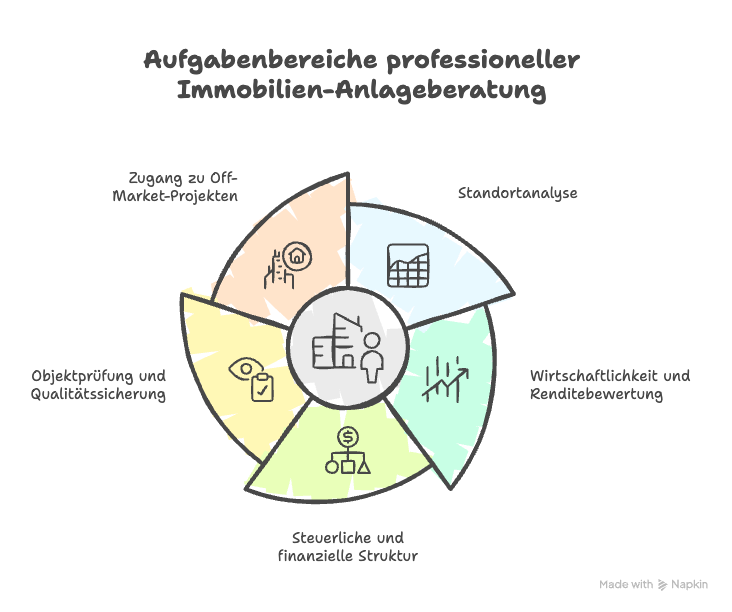
- Location analysis with genuine market access
Experts use databases and tools that go far beyond public platforms. They identify trends early, assess migration, new construction activity, and rental development, and can evaluate opportunities and risks significantly better. - Profitability and Return Evaluation
Each property is evaluated based on its yield, cash flow, and multi-year projections. This quickly reveals whether it aligns with personal goals, such as wealth accumulation, retirement planning, or tax optimization. - Tax and Financial Structure
A solid strategy considers tax effects such as depreciation (AfA), special depreciation, or the deductibility of interest and modernization costs. Coordination with a tax advisor ensures a long-term sustainable financing structure. - Property Due Diligence and Quality Assurance
Pre-selected properties are offered through vetted networks and long-standing relationships. Independent experts also assess the building structure, energy efficiency, and potential risks. - Access to Off-Market and Vetted Projects
Through established partner networks, investors gain access to vetted and often unlisted properties. These off-market deals arise from close relationships with project developers, property managers, and banks, often offering better terms.
A good property is no accident, but the result of a clear strategy and professional preparation.
Conclusion: Is real estate a worthwhile investment for doctors?
In many cases: Yes, provided it is professionally planned and structured.
A carefully selected, wisely financed, and tax-optimized property can:
- a strong component for wealth and retirement planning be,
- create relatively stable, currency-independent value,
- reduce taxes, and provide solid cash flow.
It becomes risky when:
- purchases are made based solely on a gut feeling or a property listing without any analysis,
- quality and location factors are ignored,
- financing is over-leveraged and lacks a buffer,
- or professional guidance is completely foregone.
Doctors, in particular, possess many ideal prerequisites: a stable and high income, good access to bank financing, and a high degree of professional predictability. Anyone who also has a time horizon of at least ten years and is willing to seek support has excellent opportunities to build lasting wealth.
When properly structured, real estate does not become a source of stress, but rather an extremely stable, currency-independent cornerstone of a private portfolio. Crucial to this are a clear strategy, professional property due diligence, and structured implementation—this is precisely where our Real Estate Investment for Doctors comes in.
- weitere Artikel
.jpeg)

Get to know us personally
At Wealth Doctors, we understand how demanding your daily routine is. That's why we start by informing you about your options on the market, with no pressure at all, and help you make sense of your situation. If evenings work better for you, we'll find a slot even after a late shift.
If you like what you hear, we might work together, if not, that's okay too.