US life settlements: The perfect investment for physicians?


As their careers progress, many doctors want not only to invest their assets profitably but, above all, to secure them in a value-stable manner. Between hospital routines and practice operations, there's little time to delve deeply into time-consuming investment forms like real estate or active stock management. This leads many doctors to ask: Is there an investment vehicle where they can indirectly use their own medical expertise as a basis for valuation, which simultaneously protects capital and invests independently of traditional market movements? US secondary market policies, or life settlements, could be precisely the alternative investment vehicle that offers stable returns with low volatility.
This guide explains what these "used" life insurance policies are all about, how they work, what advantages and risks they entail, and how doctors, in particular, can benefit from them. We also show how Wealth Doctors assists with investments in US secondary market policies and what to look out for.
What are US Life Settlements?
US secondary market policies are existing life insurance policies from the USA that are sold by their original owner to investors. For investors, they primarily represent a strategic addition to existing investments such as stocks, real estate, or funds, as they introduce an additional, largely market-independent source of income into the portfolio. Instead of simply canceling a policy and receiving only the low surrender value from the insurance company, the policyholder in the USA can sell their policy on the secondary market to a third party, thereby enabling investors another form of diversification and asset protection.
The investor then takes over the premium payments and, in return, receives the agreed-upon death benefit upon the death of the insured person.
This concept has been practiced in the USA since a landmark Supreme Court ruling in 1911 (Grigsby vs. Russell case) and has created an established market. In Germany, however, there is no comparable broad secondary market for life insurance policies, as these have a fixed term and therefore do not guarantee a payout if the person lives longer.
US secondary market policies are therefore also used by European investors to benefit from the regulated practice in the USA of utilizing life insurance policies on the secondary market. They are often referred to as "used" life insurance policies or, in industry jargon, as life settlements.
A typical US secondary market policy, for example, is a whole life insurance policy of an older or seriously ill US citizen (often 70+ years old) who no longer needs the insurance or no longer wishes to pay the premiums. Often, specific reasons lie behind the desire to sell, such as high hospital and treatment costs or the wish to fulfill a last dream and consciously shape their remaining lifetime. By selling the policy, the policyholder receives immediate liquidity, which makes these plans possible.
A specialized company determines the value of the policy based on the insured person's remaining life expectancy, the sum insured, and the expected premiums.
The investor buys the policy for an amount that is higher than the surrender value but significantly lower than the actual insurance benefit. Both sides benefit: The seller immediately receives an attractive sum in cash and gains financial flexibility, while the buyer (investor) can expect a predictable return when the policy eventually pays out.
How does the secondary market for Life Insurance work?
The secondary market process can be outlined in a simplified form as follows:
A policyholder in the USA, usually elderly or seriously ill, sells their life insurance policy through a licensed life settlement provider. This provider examines the policy and the insured person (including health data) and brokers the sale to investors. These investors select policies based on the complete health data provided by the sellers.
Practical Example:
A seriously ill 58-year-old policyholder sells their term life insurance policy worth 1,000,000 USD on the secondary market for 500,000 USD and receives immediate liquidity.
The buyer takes over the premium payments and, in the event of a claim, receives the guaranteed sum insured of 1,000,000 USD. The return is derived from the difference between the purchase price, ongoing costs, and the eventual payout.
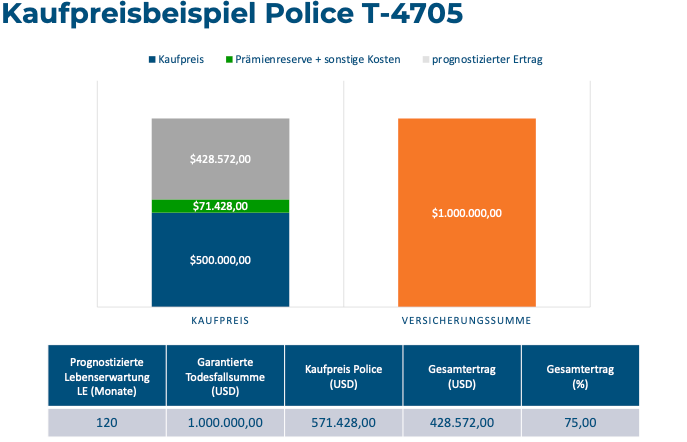
As a German investor, you do not deal directly with the US market. The investment is made through a trust or custodial structure: the buyer becomes the beneficial owner of one or more US life insurance policies, including all rights to the death benefit.
What makes the mechanics behind the market predictable:
- Financially strong insurance companies such as MetLife, Prudential, or New York Life with top-tier credit ratings (A+ / A++ from A.M. Best)
- A strictly regulated market with clear legal frameworks for life settlements that protect both buyers and sellers
- A market established since 1911, with an annual trading volume in the tens of billions of US dollars
- Also relevant for institutional investors such as pension funds and family offices, as a calculable portfolio component
(Note: In Germany, profits from life settlement investments are generally taxed for private investors like other capital investments with the flat-rate withholding tax (25% plus solidarity surcharge/church tax). Details can be found in the FAQ section.)
Advantages and Disadvantages of US Secondary Market Policies
US secondary market policies differ significantly from classic capital investments in their risk-reward structure. Due to their medical background, physicians benefit from a particularly interesting risk-reward profile.
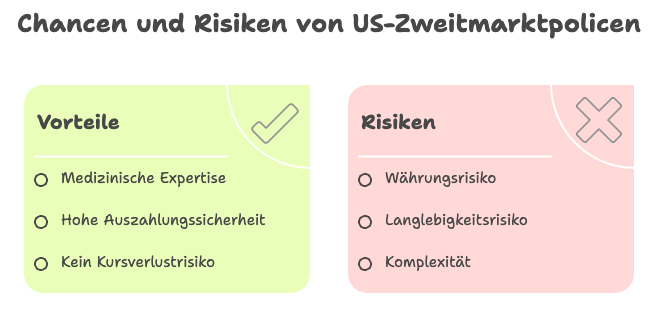
Opportunities:
- Return logic based on medical Expertise
Financial performance is not based on stock market forecasts or market sentiment, but on medical analysis. Before every investment, health records are evaluated and supplemented with independent life expectancy assessments, a principle that is particularly intuitive for physicians, who work with diagnoses and statistical evidence rather than speculation. If the insured person passes away earlier than calculated, this results in additional performance potential.
- Structurally Very High Payout Security
The death benefit is contractually guaranteed, it is not an option, a market value, or an estimate, but a fixed, defined insurance sum. The policies come from some of the most financially stable insurance companies in the world, which is why institutional investors also use life insurance policies as solid collateral. The payout depends on a biological event that is certain to occur, only the timing remains open.
- Different risk logic than stocks or funds
While the market value of stocks, funds, or real estate can fall permanently below the purchase price, a secondary market policy ultimately pays out the contractually fixed insurance sum. A negative outcome is only conceivable if the insured person lives significantly longer than the projected life expectancy, and even then, typically only the return decreases, not the invested capital.
Opportunities:
- Currency risk (USD/EUR)The payout is made in US dollars, an unfavorable exchange rate can reduce the return in euros.
--> Exchange rates move cyclically. With sufficient time flexibility, the payout date can be chosen strategically, or part of the position can deliberately be held as dollar exposure.
- Longevity risk
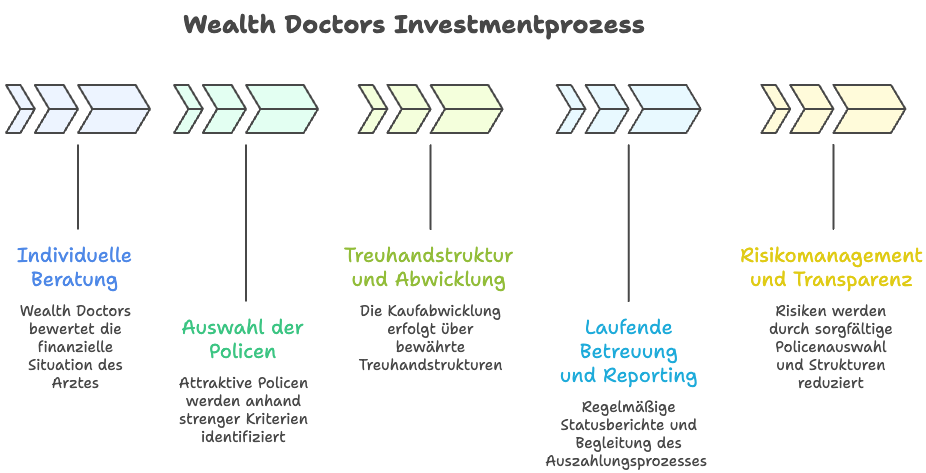
If the insured person lives significantly longer than projected, the capital commitment period extends and additional premiums are due, reducing the return.
--> Medical assessments, conservative calculations, and premium buffers reduce this risk. In practice, a longer lifespan means a lower return, not a loss of capital.
- Complexity and provider selection
The market is specialized and legally demanding, a lack of experience or inefficient structures can cost returns.
--> With a specialized partner, policies are carefully reviewed, cost structures are made transparent, and the process is professionally managed.
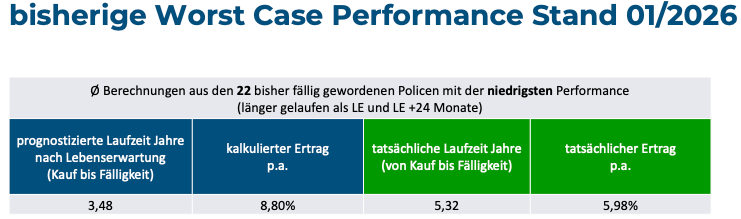
How Wealth Doctors Supports Your Investment
Wealth Doctors supports physicians comprehensively and systematically with sophisticated investments such as US secondary market policies. The investment is made as a direct investment in individual policies, not through a fund. This way, the investor retains full control over policy selection and avoids ongoing fund costs.
1. Individual Consultation
First, we assess whether life settlements align with your financial goals and individual situation. Investment horizon, liquidity needs, and risk tolerance are analyzed, and all relevant aspects are transparently explained.
2. Policy Selection
Attractive policies are identified based on strict criteria. Only policies from first-class companies with high ratings are selected. Each policy undergoes a double medical review.
Before investing, full transparency is provided regarding the sum insured, health data, determined life expectancy, and the insurer's rating.
3. Trust Structure and Settlement
The purchase process is handled through established trust structures. The invested capital flows into a secured escrow account and from there into the policy purchase.
The policy is placed into a trust or a similar structure. Legal partners ensure a legally sound and clean transaction. The ongoing administration is handled by the trustee company.
4. Ongoing Support and Reporting
Following the investment, regular status reports are provided. Should the insured event occur, the payout process is professionally managed.
Furthermore, there is the option to immediately reinvest disbursed amounts into new policies. If a direct reinvestment occurs without funds flowing to the private level, the tax on the realized gain is generally not triggered initially. This allows for continued utilization of the compound interest effect and strategic expansion of the capital base.
Macroeconomic developments such as exchange rates are continuously monitored.
5. Risk Management and Transparency
Risks are reduced through careful policy selection, dual medical assessments, and financial buffers. Costs and fees are disclosed transparently.
US Secondary Market Policies: The Perfect Investment for Doctors? A Conclusion
In recent years, US secondary market policies have established themselves as a lucrative and crisis-resistant niche investment. For doctors seeking a secure investment, who can commit capital for several years, wish to diversify their assets more broadly, and want to leverage their medical expertise in the valuation logic of an investment, these policies represent a strategically valuable addition to their portfolio.
Whether this investment form is suitable depends on individual circumstances such as investment horizon, liquidity situation, and risk profile.
The key aspects can be summarized as follows.
- Stable Returns Independent of Markets: Life Settlements enable predictable returns in the mid-single to low double-digit percentage range per year, regardless of economic cycles and stock markets. This creates a stable and predictable component in the portfolio.
- Manageable Risk Through Professional Selection:
Risks such as increased longevity of policyholders or currency fluctuations are quantifiable and can be mitigated through diversification, buffers, and structured analysis. - Suitable for investors with a medium to long-term horizon: US secondary market policies are particularly suitable for investors who can commit capital for several years and are looking for a strategic addition outside traditional market cycles.
- De-risking and Diversification: As a largely market-independent source of returns, US life insurance policies complement existing investments such as equity funds, real estate, or private equity, and enhance the structural resilience of the overall portfolio.
US secondary market policies are not a panacea and are not suitable for every investor profile. However, for physicians with available capital and a clear focus on security, predictability, and diversification, they can represent a substantial addition to their asset structure.
Disclaimer: This article is for informational purposes only and does not constitute investment advice in the legal sense. Any investment decision should be tailored to individual circumstances.
- weitere Artikel


Get to know us personally
At Wealth Doctors, we understand how demanding your daily routine is. That's why we start by informing you about your options on the market, with no pressure at all, and help you make sense of your situation. If evenings work better for you, we'll find a slot even after a late shift.
If you like what you hear, we might work together, if not, that's okay too.