Top tax tips 2026 for doctors: Save smartly and sustainably with investments


Doctors in Germany are among the top earners. However, this high income comes with a correspondingly high tax burden, which often reaches up to 45 percent. As a result, many medical professionals feel that despite their good pay, they are not keeping enough of their own income. But there are ways to reduce this burden. Targeted tax optimization for doctors helps to reduce levies and create financial flexibility. Those who optimize their investments for tax purposes not only save money on taxes but also build wealth at the same time.
In this article, we show which investment strategies are particularly sensible for doctors from a tax perspective. This article focuses exclusively on tax-optimized securities investments and not on real estate, which will be covered in the second part, Saving taxes with real estate .
Retirement provision as a tax-optimized investment
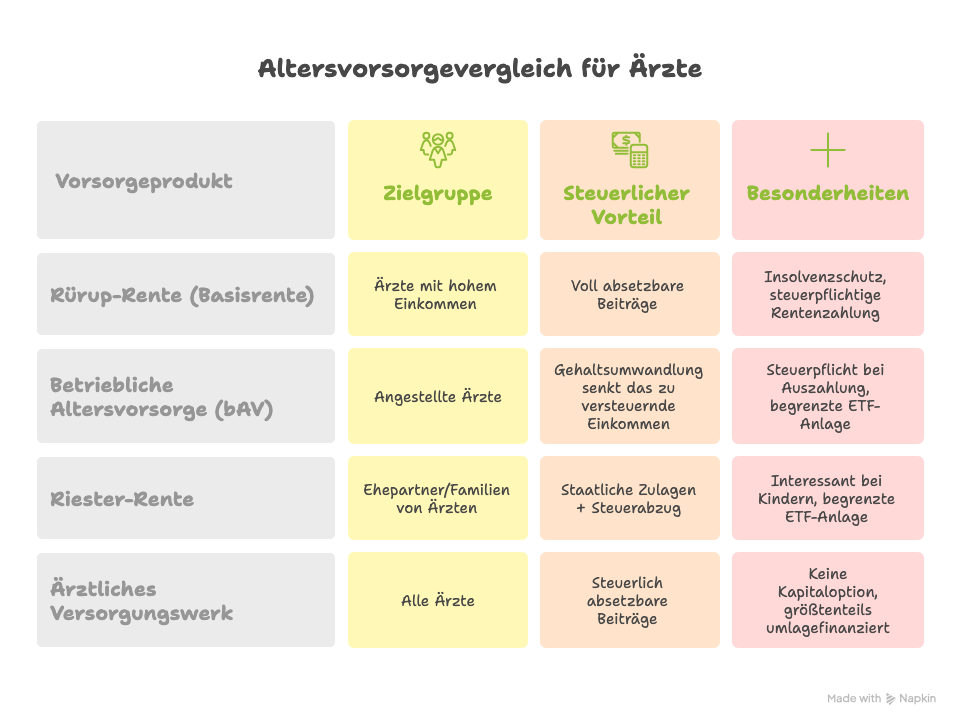
Retirement provision is one of the most important levers when it comes to saving taxes. Although doctors pay deductible mandatory contributions to their professional pension scheme, these are rarely enough to secure their accustomed standard of living in retirement. To close this gap, legislation provides various options for building wealth while simultaneously saving taxes:
Rürup pension: An attractive foundation for doctors in the top tax bracket
The Rürup pension, also known as the basic pension, is particularly interesting for doctors who pay the maximum income tax rate. According to Section 10 of the German Income Tax Act (EStG), contributions are classified as pension expenses, which are tax-deductible up to certain maximum amounts. This significantly reduces the tax burden every year.
The form of investment can be chosen freely and adjusted over time.
However, it should be noted that the invested sums can only be paid out in the form of a lifelong pension from the age of 62 at the earliest.
Company pension schemes: Benefits for employed physicians
For employed physicians, a company pension scheme lowers taxable income because a portion of the gross salary goes directly into the pension plan. It becomes particularly worthwhile with an employer contribution of at least 20 percent. However, the potential returns are lower than with a Rürup pension, as large portions of the capital cannot be invested in ETFs.
Riester pension: Interesting in specific cases
For physicians, the Riester pension is usually of limited use, as members of a professional pension fund (Versorgungswerk) are not personally eligible. It can still be worthwhile through a spouse, especially for families with children, as subsidies and tax deductions for special expenses have the greatest impact here. As with company pension schemes, however, investment options are limited.
Source: Created with Napkin.ai
Practical example: How a physician saves taxes with the Rürup pension
Dr. Müller, a physician in private practice, has an annual income of €150,000. He decides to contribute €20,000 to a Rürup pension plan. Since the contributions are fully tax-deductible under Section 10 of the German Income Tax Act (EStG) , his taxable income is reduced accordingly.
With a tax rate of approximately 42% , Dr. Müller saves around €8,400 in taxes. This means the contribution effectively costs him only €11,600, while the full €20,000 goes toward his retirement savings. In this way, a supposedly high tax burden is transformed into a strategic investment in the future.
Make the most of capital market investments
ETFs, funds, and stocks promise solid long-term returns and are therefore a key component of balanced wealth accumulation. In Germany, capital gains are generally subject to capital gains tax. The capital gains tax on profits from stocks, funds, or interest in Germany is 26-28% (including the solidarity surcharge and, if applicable, church tax).
With the right strategies, doctors can significantly reduce their tax burden and keep more capital in their portfolios.
Make the most of the tax-free savings allowance
The first step toward tax optimization in the capital market is utilizing the tax-free savings allowance (Sparerpauschbetrag). Single individuals can keep up to 1,000 euros in capital gains tax-free, while for married couples, the allowance is 2,000 euros per year. By submitting an exemption order (Freistellungsauftrag) to your bank, you ensure that these amounts are not taxed unnecessarily. This simple yet effective step is particularly worthwhile for doctors who invest regularly in ETFs or funds.
Important to know: Children also have their own tax-free savings allowance. Therefore, savings plans should ideally be set up in the child's name to make optimal use of their tax-free allowances.
Leverage the tax benefits of funds
Another important point is the partial tax exemption for funds. For equity funds, 30 percent of returns are tax-free, and for real estate funds, it is as much as 80 percent. This tax bonus makes funds even more attractive compared to individual stocks, as it increases the net return. Therefore, those investing for the long term should keep the tax treatment in mind when selecting funds.
Buy-and-hold and accumulation as a tax advantage
A long-term investment strategy offers additional benefits for doctors. Profits from stocks and funds are only taxed upon sale. By investing according to the "buy-and-hold" principle, you defer the tax burden into the future and benefit from the compound interest effect in the meantime. Accumulating funds, which automatically reinvest their earnings, are particularly interesting. This allows the invested capital to grow continuously without incurring annual taxes on distributions.
Portfolio example: How a tax-optimized portfolio works
A simple example shows how effectively these individual levers work together. Suppose a doctor realizes a profit of 5,000 euros from their securities portfolio in one year.
Without tax optimization—for example, with individual stocks and an unused allowance—the full 5,000 euros are taxable. At a flat-rate tax of approximately 26.4 percent, this results in about 1,319 euros in taxes.
If the doctor opts for an equity ETF instead and consistently utilizes the leverage, the calculation looks different:
- Partial tax exemption: For equity funds, 30 percent of the returns are tax-free, leaving 3,500 euros subject to tax.
- Saver's allowance: A further 1,000 euros of this is tax-free, meaning only 2,500 euros are taxable.
- Tax: This results in approximately 659 euros in tax.
The tax burden is thus halved from around 1,319 to 659 euros, despite the profit being identical. Those who also invest according to the buy-and-hold principle defer the taxation of capital gains far into the future, allowing compound interest to work for them in the meantime.
Conclusion: Saving on taxes is legal and sensible
Doctors have numerous ways to reduce their tax burden while simultaneously building wealth. Whether through a Rürup pension, company pension schemes, or capital market investments, there is a wide range of options. The key is to find the right combination that fits your personal situation. With professional support, you can specifically leverage the appropriate tax advantages so that more of your income remains at the end of the day.
The second part shows how this can be implemented with real estate, for example Saving taxes with real estate. And insurance should also be considered: specifically private health insurance or occupational disability insurance offer scope for tax planning.
With the right strategy, a supposedly high tax burden becomes a real opportunity: fewer payments to the state, more financial flexibility, and long-term security.
Get to know us personally
At Wealth Doctors, we understand how demanding your daily routine is. That's why we start by informing you about your options on the market, with no pressure at all, and help you make sense of your situation. If evenings work better for you, we'll find a slot even after a late shift.
If you like what you hear, we might work together, if not, that's okay too.