Occupational disability for doctors: understand it properly and secure optimal protection


The Occupational Disability Insurance for Physicians (BU) is one of the most important forms of protection in a medical career. It protects physicians from the financial consequences if they can no longer practice their profession, either fully or partially. Especially for young physicians, the question arises early on whether coverage through their professional pension scheme alone is sufficient. In this article, you will learn the differences, why early enrollment makes sense, and how to find the right policy.
Why Occupational Disability Insurance can be Crucial for Physicians
Even though physicians are covered by their professional pension scheme, this protection is often insufficient. Benefits usually only kick in with full occupational disability, meaning when no medical activity is possible anymore. In reality, this is only the case in rare exceptions.
Private Occupational Disability Insurance (BU) , on the other hand, pays out even with 50 percent occupational disability and focuses on the last profession practiced. Whether a BU is worthwhile depends on income, ongoing commitments, loans, and long-term life planning.
Differences Between Professional Pension Scheme and Private Occupational Disability Insurance (BU)
The BU pension from the professional pension scheme is only paid when a full occupational disability is present. This means that physicians can no longer fully perform their medical activities. A surgeon who can no longer operate but could still write expert opinions or work in teaching receives no benefits.
The private Occupational Disability Insurance (BU) kicks in significantly earlier. Even with a 50 percent impairment, the agreed-upon pension is paid. Good policies also waive so-called reassignment clauses, which could otherwise refer you to another profession or areas of activity within your own profession. This way, you are financially protected if you can no longer perform your specific medical activities.
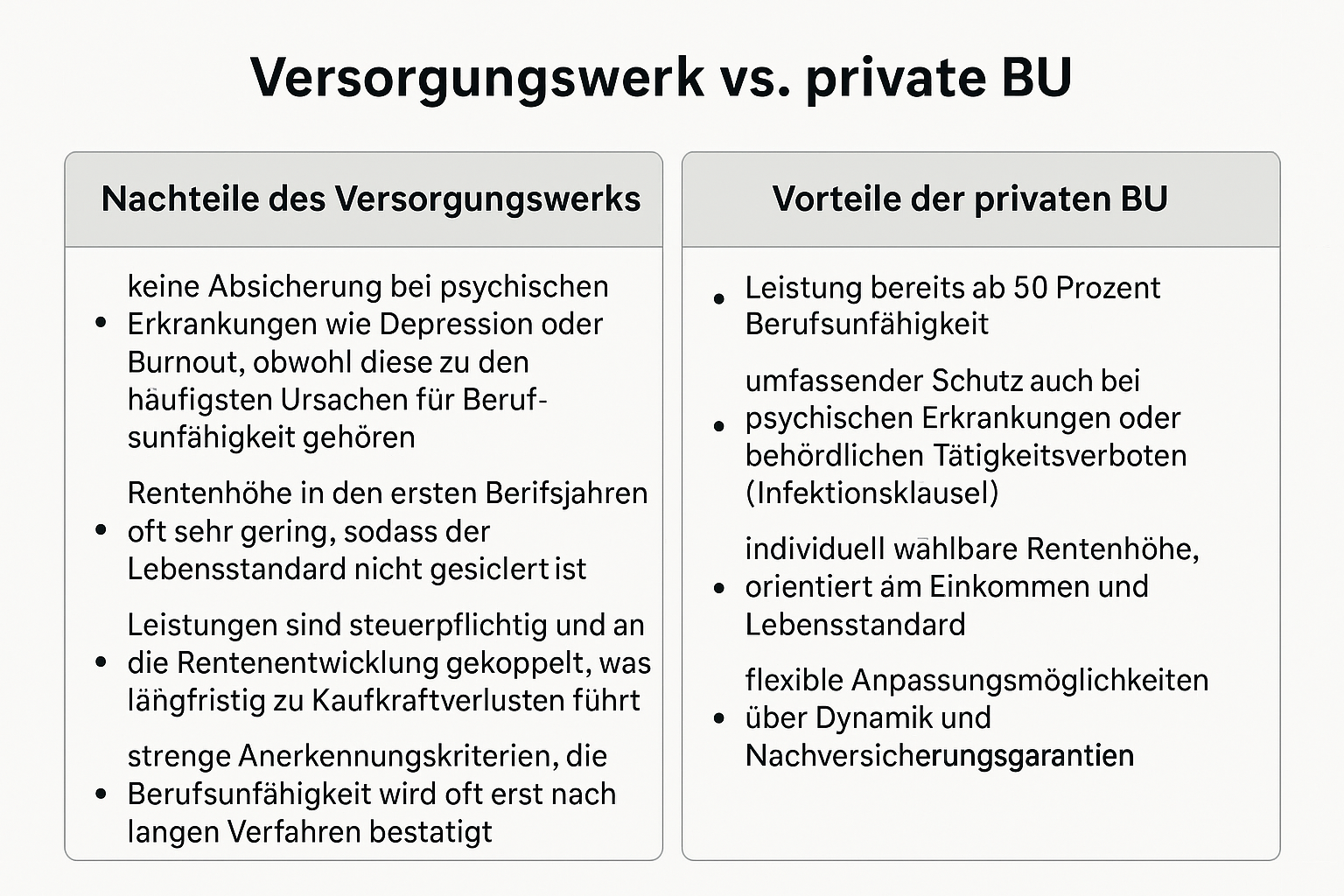
Disadvantages of the Professional Pension Scheme at a Glance
- No coverage for mental illnesses like depression or burnout, even though these are among the most common causes of occupational disability
- Pension amount often very low in the early years of employment, making it difficult to maintain one's standard of living
- Benefits are taxable and linked to pension trends, leading to a long-term loss of purchasing power
- Strict eligibility criteria; occupational disability is often only confirmed after lengthy procedures
Advantages of Private Occupational Disability Insurance
- Benefits payable from 50 percent occupational disability
- Comprehensive coverage, including for mental illnesses or official prohibitions on activity (infection clause)
- Individually adjustable pension amount, based on income and standard of living
- Flexible adjustment options through dynamic clauses and guaranteed increases
What Doctors Should Look For When Choosing a Policy
Not all occupational disability insurance policies for doctors are created equal. The differences often lie in the contract details. These specific points determine whether you are truly covered or if there are gaps in an emergency. Therefore, you should pay particular attention to the following criteria:
Infection Clause
For doctors, the Infection Clause is of central importance. It applies when an official ban on activity is issued, for example, due to the risk of infection. Even if you are physically healthy, you would no longer be able to practice your medical profession in such a case. With an infection clause, you receive benefits; without it, your protection would be incomplete in such situations.
Reassignment Clause
Almost all occupational disability policies waive the abstract reassignment. This means you don't have to accept another profession just because you are theoretically capable of doing so. With concrete reassignment the insurer can stop benefits if you are already actually working in a comparable activity, such as an expert or consultant. For surgeons in particular, waiving the concrete reassignment clause is especially important, as this is the only way to truly protect their core activity.
Premium Information
Pay attention to how large the difference between gross premium and net premium is.
- The gross premium is the maximum premium and is guaranteed.
- The net premium is the actual premium to be paid, reduced by the insurer's surpluses.
If the profit participation decreases, the net premium can increase. With high-quality companies, this difference is a maximum of 35%. If there is a large gap between the two premiums, the risk of experiencing significant premium increases in the future rises.
Guaranteed increase option
The guaranteed increase option is particularly important for doctors. It allows you to increase your disability insurance benefit in the event of life changes such as marriage, birth of a child, salary increase, or starting a practice, without a new health check. This keeps your coverage flexible and allows it to grow with your career.
Automatic adjustment
The automatic adjustment ensures that the benefit amount and premiums automatically adjust each year. This keeps your disability insurance stable against inflation and rising income. An annual adjustment of between two and five percent is recommended. Without this adjustment, the purchasing power of your disability insurance benefit decreases over the years.
Many companies offer the option to suspend the automatic adjustment without losing the right to future increases.
Occupational Disability Insurance at Different Career Stages
The requirements and risks in the medical profession change significantly depending on the career stage. Accordingly, occupational disability insurance for doctors should be adapted. At the same time, the terms of an occupational disability policy depend heavily on age and medical specialty, changing as a career progresses. The decisive factor here is health status: if pre-existing conditions arise, this leads to risk surcharges or, in extreme cases, rejection. Depending on the career phase, this results in different starting points.
Medical Studies
Many doctors secure basic coverage while still in medical school. The advantage lies in the early health assessment: as long as there are no pre-existing conditions, the contract is accepted without restrictions and can be increased later via the guaranteed insurability option without further medical underwriting.
Starting early is particularly worthwhile for students, as pre-existing conditions are rarely an issue and insurers offer attractive entry-level rates. Those who take out occupational disability insurance during their medical studies secure the best conditions for low premiums and maximum flexibility.
Residency and Specialization Period
There is an often-overlooked advantage during specialist training. Some insurers still classify resident physicians in a more affordable occupational group, even if their future work will be in a higher-risk field like surgery. Securing this classification early on allows you to benefit from permanently lower premiums compared to waiting until you have completed your specialist training.
Specialist, Senior Physician, Chief Physician & Private Practice
As your professional experience and income grow, so do your insurance needs. As a rule of thumb, your disability pension should be 75 to 80 percent of your net income to cover your ongoing expenses.
Thanks to guaranteed insurability options, physicians can adjust their disability pension following events such as salary increases, opening a practice, marriage, or the birth of a child without undergoing a new medical exam. This ensures your coverage remains current and flexible.
For self-employed physicians or those in private practice, it is particularly important to protect not only your own standard of living but also fixed practice costs. This includes rent, equipment leasing installments, and personnel costs. Policies with reorganization clauses and concrete referral provisions are crucial here to provide the best possible protection for your specific medical practice.
Is combining with a pension plan advisable?
Some insurers offer the option to combine occupational disability insurance directly with a pension plan. This is possible either as a Flex or a so-called Rürup pension with an additional occupational disability component. At first glance, this solution can seem attractive because both important issues – protecting your earning capacity and building up your retirement pension – are combined in one contract.
Advantages of a Combination Solution
A combination contract offers several advantages. If occupational disability never occurs, it ensures that funds from the contract are still paid out. Furthermore, with a Rürup pension, contributions for the occupational disability insurance can be tax-deductible, which reduces the monthly cost. In addition, in the event of occupational disability, the insurer takes over the contributions for the pension plan. This means that even with a prolonged illness or an occupational ban, the pension plan continues.
Disadvantages of a Combination Solution
However, the disadvantages should not be underestimated. Combination contracts are less flexible because they link both types of coverage. Anyone who cancels or pauses the contract typically loses both the occupational disability insurance coverage and the pension plan component. Furthermore, the choice of providers is limited. The best occupational disability insurer is not automatically the best provider for pension plans. Another disadvantage: the occupational disability pension from a Rürup pension is usually fully taxable.
Alternative: Two-Contract Solution
A popular alternative is the two-contract solution. Here, a standalone occupational disability insurance policy is taken out, and the pension plan is set up either separately or with an additional occupational disability component. This option offers more flexibility, as both contracts can be designed, adjusted, or cancelled independently. When structured correctly, this can at least allow occupational disability contributions to be partially tax-deductible, while avoiding the disadvantages of subsequent taxation of the occupational disability pension. The contract durations can also be planned separately, which creates additional freedom.
Occupational disability consulting with Wealth Doctors
Sound occupational disability coverage requires more than just a tariff comparison. We understand not only the market landscape but also the specific career paths of physicians and the tailored options that fit them. Whether a combination of different modules makes sense or the term should be adjusted depends on your specific situation. We base your coverage on exactly that, rather than simply brokering a standard product.
What matters most is not what looks best on paper today, but what actually delivers when you need it most. We focus specifically on the policy terms that make the difference in the event of a claim and take full responsibility for structuring your coverage. This ensures you have a specialized advisor by your side, making sure your protection doesn't just look good now, but truly works when it counts.
You can find more information on our page about Occupational disability insurance for doctors. There, you will find all the details and can request a no-obligation consultation directly.
Get to know us personally
At Wealth Doctors, we understand how demanding your daily routine is. That's why we start by informing you about your options on the market, with no pressure at all, and help you make sense of your situation. If evenings work better for you, we'll find a slot even after a late shift.
If you like what you hear, we might work together, if not, that's okay too.