Buying property as a young doctor: When is the right time to get started?


Many young doctors eventually wonder whether real estate fits into their wealth strategy.
Structuring an investment property correctly requires a willingness to engage with numbers, financing and strategy. Those who are not prepared to do so will not achieve sustainable success. This article is also not suitable for doctors who fundamentally do not see real estate as a component of their wealth strategy, or who are specifically planning to leave Germany within the next two to three years and will no longer have taxable income here.
This article deals exclusively with investment properties, i.e., rented real estate used specifically for wealth accumulation. Owner-occupied residential property follows different rules, particularly regarding taxes, and is often more of an emotional than a purely economic decision.
The following sections break down the decision step by step: when it makes strategic sense to get started, what applies during different career phases, what banks look for in financing, which tax levers are decisive, and which mistakes young doctors should avoid when making their first purchase.
Disclaimer: This article is for general information purposes only and does not constitute individual financial, tax, or legal advice.
Why real estate as an investment is attractive to many doctors
For many doctors, stocks, ETFs, and funds are simply too abstract. The value of a stock is intangible, and the mechanics behind it are often difficult for people without a financial background to grasp. Real estate, on the other hand, is more tangible. It follows an intuitive valuation and basic principle: buy, rent out, generate income, and ideally, increase in value. For many doctors, this form of investment is often the most logical entry point into structured wealth accumulation.
In addition, there are three economic advantages that are particularly relevant for young doctors:
- Leverage. An investment property should ideally be primarily financed, as the leverage effect is a central principle of this type of investment. With relatively little equity, a significantly larger amount of wealth can be built through bank financing.
- Tax deductibility. Mortgage interest, depreciation, management costs, and maintenance expenses can be claimed for tax purposes when renting out a property. With a professionally set-up structure, even small properties can result in tax refunds in the four- or five-figure range.
- Income and appreciation. A good real estate strategy can generate positive cash flow in the long term. Most investors realize the significant increase in wealth upon sale, which is generally tax-free after a holding period of ten years.
However, an investment property is not a "set it and forget it" asset. Those who do not plan for professional property management or try to buy as "cheaply" as possible risk the subsequent effort becoming an additional burden.
When does it make strategic sense to start investing?
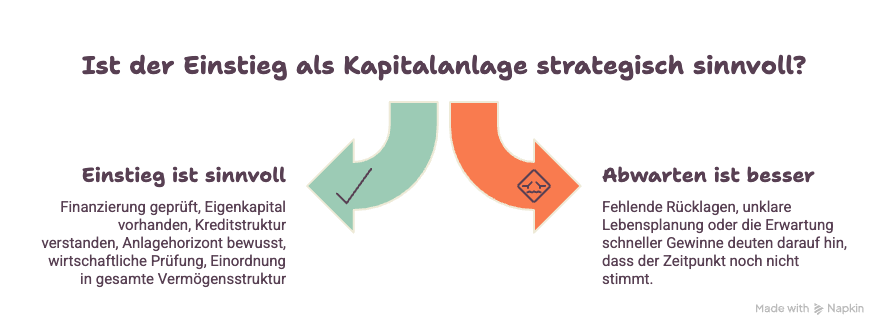
An investment property is generally a medium-term investment decision. The significant increase in wealth is realized upon sale, not during day-to-day operations. Anyone expecting quick profits will be disappointed. However, those who have a time horizon of at least ten years and meet the following requirements can systematically evaluate getting started.
The seven requirements at a glance
- Are the financing requirements met? Stable income situation, no major consumer loans, and sufficient creditworthiness.
- Is there enough equity available for the incidental purchase costs? Depending on the federal state, this amounts to 5 to 12 percent of the purchase price.
- Is the difference between an investment loan and a consumer loan understood? A loan for an investment property is structurally different from an installment loan and follows a different logic.
- Is the time horizon accepted? Anyone who needs to sell in five years should not buy.
- Has the property been thoroughly vetted from an economic perspective? Purchase price, rent, yield, condition, and tax impact must be calculated before the purchase, not after.
- Are insurance and retirement planning secured in parallel? A property is no substitute for disability insurance or retirement planning.
- Is the purchase integrated into an overall plan? Life goals such as family planning, home ownership, or starting a practice should be taken into account when buying.
When waiting is the better decision: A lack of savings, unclear life plans, a lack of willingness to engage with the subject matter, or the expectation of quick profits are clear signals that the time is not yet right.
Resident, specialist, senior physician: What always applies and what differs
Regardless of their career stage, doctors should almost always follow three basic rules:
- A professional property management should be planned for from the very beginning. An investment property should remain a passive investment and not become a burden on your career.
- The decision to purchase a property should not be made emotionally, but based on complete financial data, structural model calculations, and stress scenarios.
- Personal life stage, family planning, and medium-term capital requirements are all taken into account before purchasing.
From an economic perspective, many doctors wait too long to make their first real estate investment because they are waiting for more stability. In principle, however, good investment opportunities often arise as early as the first year of residency.
.png)
Financing: Why doctors have a head start with banks
Doctors are considered creditworthy by banks because their income is predictable and there is structurally stable demand for their profession. However, this does not mean that the terms are always automatically optimal. The decisive factors are income, equity, credit rating, loan-to-value ratio, and property quality in the overall assessment.
An often underestimated aspect: A well-structured investment property improves your credit rating over time. Rising rental income and an increasing property value are viewed positively by banks and create a better starting position for future projects, including financing for a primary residence or a medical practice.
For residents with fixed-term contracts, financing is generally possible because the law regarding fixed-term employment contracts for doctors in residency classifies these as a predictable career phase, not a risk. The individual financing structure still depends on the overall situation.
For a first-time purchase, incidental acquisition costs should be covered by equity, amounting to 5 to 12 percent of the purchase price depending on the federal state. 100% financing is possible for doctors, but it increases interest rate risk and requires an economically particularly strong property.
When it comes to repayment strategy, the rule is: lower repayments mean a lower monthly installment and higher tax deductions over the term of the loan. This can be a targeted advantage for capital investments, but it should always be evaluated in the context of the overall financing strategy .
Important to know: Regional banks often have a more precise understanding of the local real estate market and provide more realistic property valuations. Specialized providers like Apobank also offer financing models tailored specifically to physicians.
Taxes and depreciation: The underestimated lever for capital investments
The tax dimension of an investment property is not a bonus, but a central component of the calculation. If you don't factor it in from the start, you are missing out on one of the key levers of this type of investment.
For a rented property, debt interest, management costs, and maintenance expenses can be claimed as income-related expenses for tax purposes. In addition, there is the AfA (depreciation for wear and tear): it allows you to deduct a portion of the building's acquisition costs annually, as regulated in § 7 of the German Income Tax Act (EStG). The amount of depreciation depends on the building. New builds, existing properties, and special property types such as listed buildings or renovated older properties follow different rules, sometimes involving straight-line or declining-balance depreciation, and sometimes including increased deduction options for renovation costs. This makes tax planning property-specific and is one of the reasons why tax optimization as part of an overall strategy should always be planned in consultation with a tax advisor.
The bottom line: Even with a single, smaller property, annual tax benefits in the four- to five-figure range are realistic. This noticeably changes the overall return on the investment and is a lever that many physicians underestimate when making their first purchase.
The same applies to returns as it does to taxes: the initial figures alone are not enough. A complete ten-year calculation that combines the purchase price, financing costs, tax impact, maintenance, and a realistic sales proceeds is the foundation for any sound investment decision.
Common mistakes young physicians make when buying real estate
Many physicians make avoidable mistakes when buying their first property—not out of ignorance, but because the decision is made under time pressure or based on unrealistic expectations.
Focusing only on the price, not the overall calculation. A low purchase price says nothing about the profitability of a property. Location, condition, rental potential, running costs, and tax impact all work together to determine the return.
No professional calculation, deciding based on gut feeling. A property that feels good is not an investment argument. If you don't create a complete ten-year financial model, you are buying blind.
No exit strategy. The decisive factor is not just whether the property is attractive today, but whether it will be attractive to a buyer in ten years. That is exactly where the return lies.
Emotional decision. The property you would live in yourself, or one located in your own city, is rarely the best one from an economic standpoint.
No property management arranged. If you manage it yourself, you are investing time that you should be spending on your career. An investment property without professional management is not a passive investment.
Checklist: Buy now or better to wait?
If you can answer most of the following questions with yes, you have a solid foundation for the next step.
- Are the incidental purchase costs covered by equity?
- Is there a complete ten-year calculation, including tax effects and stress scenarios (vacancy, interest rate adjustments, maintenance)?
- Has the location been checked for rentability, not just the purchase price?
- Is there an exit strategy; will the property still be attractive to a buyer in ten years?
- Does the purchase fit your life plan and is it integrated into your overall wealth strategy?
- Are retirement planning and disability insurance secured in parallel?
- Is professional property management planned?
If you cannot yet answer several of these points, there is no disadvantage. It simply means that the next logical step is not to buy, but to prepare for it in a structured way.
How Wealth Doctors supports young doctors in entering the real estate market
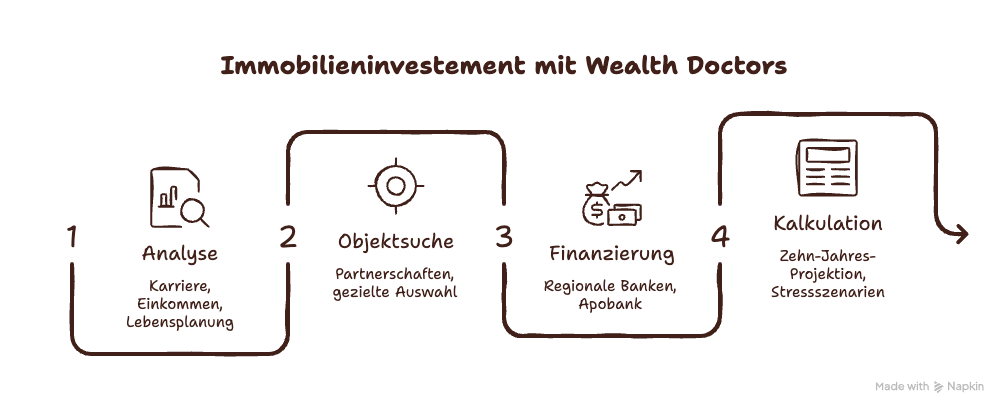
The process always begins with your overall situation: career stage, income, liquidity, life planning, and existing wealth strategy. Only when it is clear whether and in what form an investment property makes sense is a suitable structure developed. Based on this, we search for properties.
Access to properties comes from partnerships built over years with developers and project planners in relevant regions. As an independent provider, these partnerships can be specifically expanded and utilized without being tied to individual products or providers. In practice, this means: no searching on public portals, but a targeted selection of properties that fit your individual situation.
The same applies to financing. Regional banks that know the local market, as well as the Apobank, are involved depending on the specific circumstances. A complete calculation is prepared for every property, including a ten-year projection and stress scenarios, so that the decision is made on a clear numerical basis.
The entire process is initially conducted online to keep the time commitment for physicians as low as possible. You only travel for a viewing once the calculation, location, and financing have already been verified. Our support also includes assistance with documentation, the notary, and implementation, as well as ongoing integration into your overall wealth strategy.
A senior physician describes in their reviewhow they were guided through the purchase of their first property—from the economic assessment and financing structure to the final implementation—while taking into account their medical career and long-term personal and financial goals.
Frequently asked questions from physicians about buying property
When is the best time for a physician to buy their first property?
It is not age that determines this, but the prerequisites: equity for incidental costs, a viable calculation, clear life planning, and the willingness to engage with the details. Many physicians start too late because they are waiting for more stability, which is often already present in the early stages of their career.
Can I finance a property as a resident physician with a fixed-term contract?
In principle, yes. Due to the specific labor laws for physicians, banks evaluate fixed-term training contracts differently than standard fixed-term contracts. The terms depend on your equity, income, and the quality of the property.
How much equity do I need as a young physician?
At a minimum, you should cover the incidental purchase costs with your own capital, which amounts to 5 to 12 percent of the purchase price depending on the federal state. Full financing is possible for physicians, but it increases interest rate risk and requires a particularly strong property.
What is depreciation (AfA) and why is it relevant?
Depreciation (AfA) allows you to deduct a portion of a building's acquisition costs from your taxes annually. Together with mortgage interest and ongoing expenses, annual tax benefits in the four- to five-figure range are realistic even with smaller properties.
ETFs or real estate for a young physician?
It is not an either-or choice. Real estate offers leverage through borrowed capital, tax planning opportunities, and the nature of a tangible asset. ETFs offer liquidity and broad diversification. Both have a place in a well-thought-out wealth strategy for physicians their place.
Is an investment property the same as a primary residence?
No. Both follow fundamentally different rules, especially regarding taxes. An investment property is evaluated based on economic criteria, whereas a primary residence has a strong emotional component and different tax frameworks.
How long should you hold an investment property?
For a secure strategy, at least ten years, because selling after this period is generally tax-free, making it easier to calculate. An earlier sale is possible, but any profit made would then be subject to tax.
Take the next step now
Would you like to see if an investment property fits into your wealth strategy? Wealth Doctors analyzes your overall situation, develops a suitable structure, and supports you from the initial consultation through to implementation—completely online and with clear calculations. Request your individual strategy analysis now.
Get to know us personally
At Wealth Doctors, we understand how demanding your daily routine is. That's why we start by informing you about your options on the market, with no pressure at all, and help you make sense of your situation. If evenings work better for you, we'll find a slot even after a late shift.
If you like what you hear, we might work together, if not, that's okay too.